









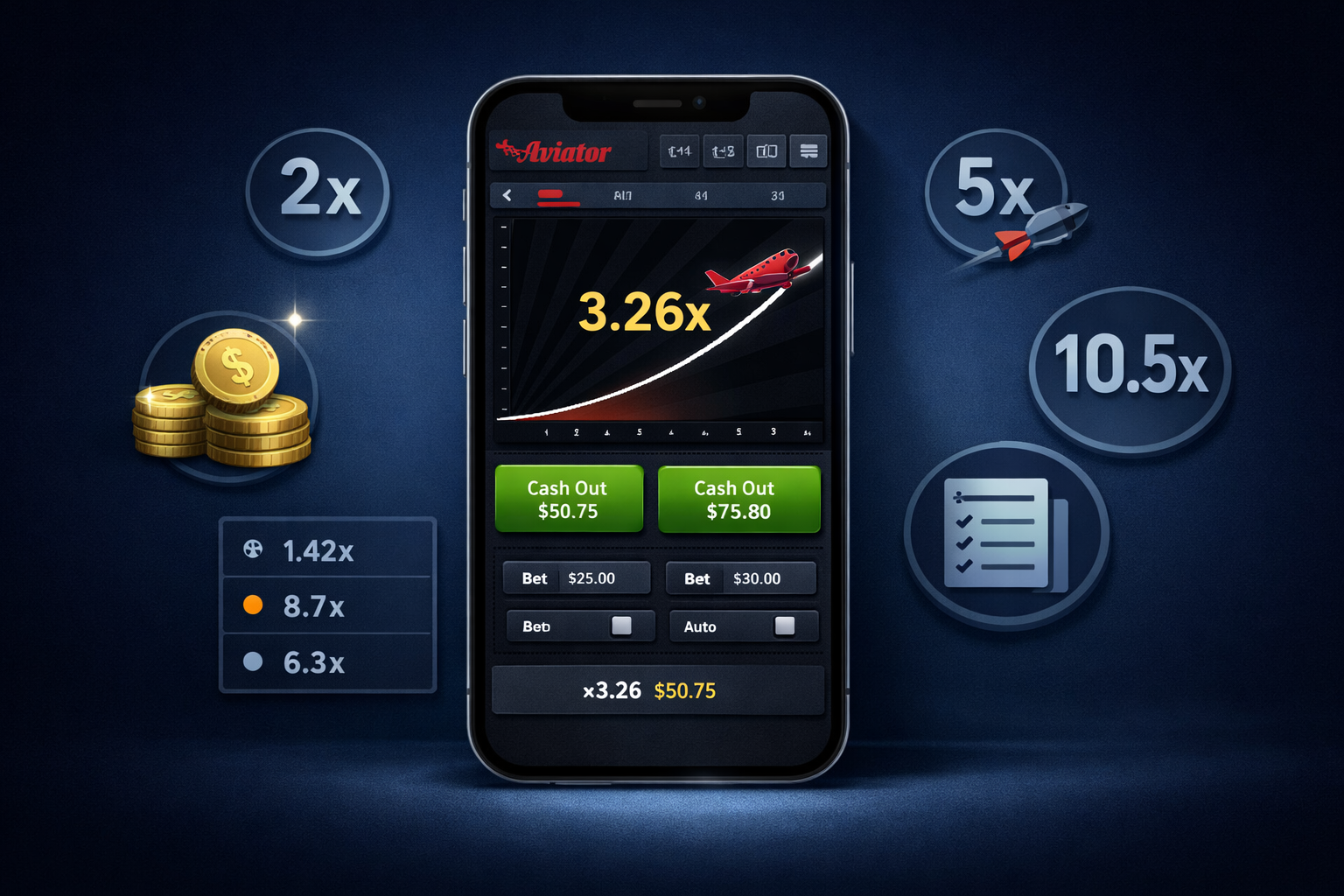
A round in crash games has a completion coefficient that is determined before the game starts. The player does not know at what multiplier the game will end. It starts at 1.00, but can end at any moment, for example, at 3.5 or 42. The player receives a win if they manage to request a withdrawal before the coefficient is cancelled, and if not, the bet is lost.
Aviator from Spribe works according to the principle described above. First, a short betting window opens, after which the plane begins to gain altitude. Along with it, the bet multiplier increases. The withdrawal button is active until the very moment when the red aeroplane leaves the playing field. But keep in mind that there are no delays or second chances in the mechanics.
How a Round Starts and Ends
One round in the Aviator online game fits into a short, strictly defined sequence. The game does not allow for pauses, rollbacks, or intermediate states. Each stage is either controlled by the player or automated:
- Accepting bets. At the beginning of the round, a window opens where you can place one or two bets and set the auto-cashout parameters. Once it closes, you cannot change the amount or settings.
- Start of flight. The plane appears on the screen and the bet multiplier is 1.00 at the start. From this moment on, the round is launched and further development takes place automatically.
- Odds growth. The multiplier increases continuously. The player can lock in the result at any time by pressing the withdrawal button if they are not using auto cashout. Control of the process is partial because the decision to exit is made by the player, while the speed of the odds growth and the moment of “crash” are set by the system.
- End of the round. At a predetermined moment, the game ends. The plane disappears, and the coefficient is fixed as complete. All bets that have not been withdrawn before this moment are cancelled. This stage is a fully automatic process that does not depend on the player’s actions.
The user controls only two things in the Aviator online game: the moment of entry and exit. Everything else is determined by the system and does not respond to the speed of clicks or other actions.
The Flight Curve and Multiplier Growth
The graph in the crash game should not be taken as a hint. The curve moves smoothly, without jerks, which creates the feeling of a controlled flight. In practice, this is a form of visualisation that is in no way related to the probabilities and dynamics of the future outcome.
The multiplier in Aviator grows non-linearly. It increases exponentially. At the beginning of the round, the coefficient grows slowly, but after a few seconds, the pace increases. However, this does not mean that the moment of “crash” is near. It means that both short and long rounds are possible in the game.
Randomness and Game Logic
The outcome of a round in Aviator is determined in advance and does not change during the game. This is a fundamental point without which it is impossible to understand how randomness works in the crash format.
What determines the moment of “crash”:
- Before the start of the round, the system calculates the coefficient at which it will end. This value is generated by the RNG and remains fixed until the end of the round. The flight of the plane only “catches up” with the predetermined end point of the process.
- Why previous rounds do not affect the next one. Each round is calculated separately. The history of multipliers is not used when forming a new value. Series of low and high coefficients do not accumulate and do not adjust future rounds.
- The flight does not carry any predictive information. The animation of the plane and the shape of the curve do not reflect the probability of a crash. They are based on the current growth of the coefficient and do not change depending on the value at which the round ends.
In other words, Aviator cannot be “read” by looking at the graph and past results. The randomness lies not in the animation, but in the predetermined coefficient value, which is only revealed at the moment of the crash.
Manual Cashout and Auto Cashout Explained
Manual cashout and auto cashout solve the same problem – they request winnings before the plane disappears, but they work in different ways. In the first case, the player chooses the moment of exit and sends a request by pressing a button. If it is processed before the end of the round, the bet is closed at the current odds. If the crash occurs earlier, the amount is simply lost.
Auto cashout works according to a predetermined multiplier. When the odds reach the value specified by the player, the system automatically sends a withdrawal request. At the same time, auto cashout does not give priority and does not bypass the general rules of the round. It works in the same time window as an independent withdrawal and is subject to the same technical restrictions.
The main caveat is that auto cashout does not insure against a crash. If the round ends at a coefficient lower than the specified value or a crash occurs at the same moment, the bet is not returned.
Why Aviator Became One of the Most Recognisable Crash Games
Aviator stands out from other games not because of the novelty of its mechanics, but because of the balance of the process. The game has no unnecessary graphic elements that distract from decision-making, and there are no hidden levels of difficulty that are revealed over time.
The player always sees the same interface and faces one choice: when to collect their money. In other words, Aviator is predictable in form at any distance, regardless of the number of rounds played.